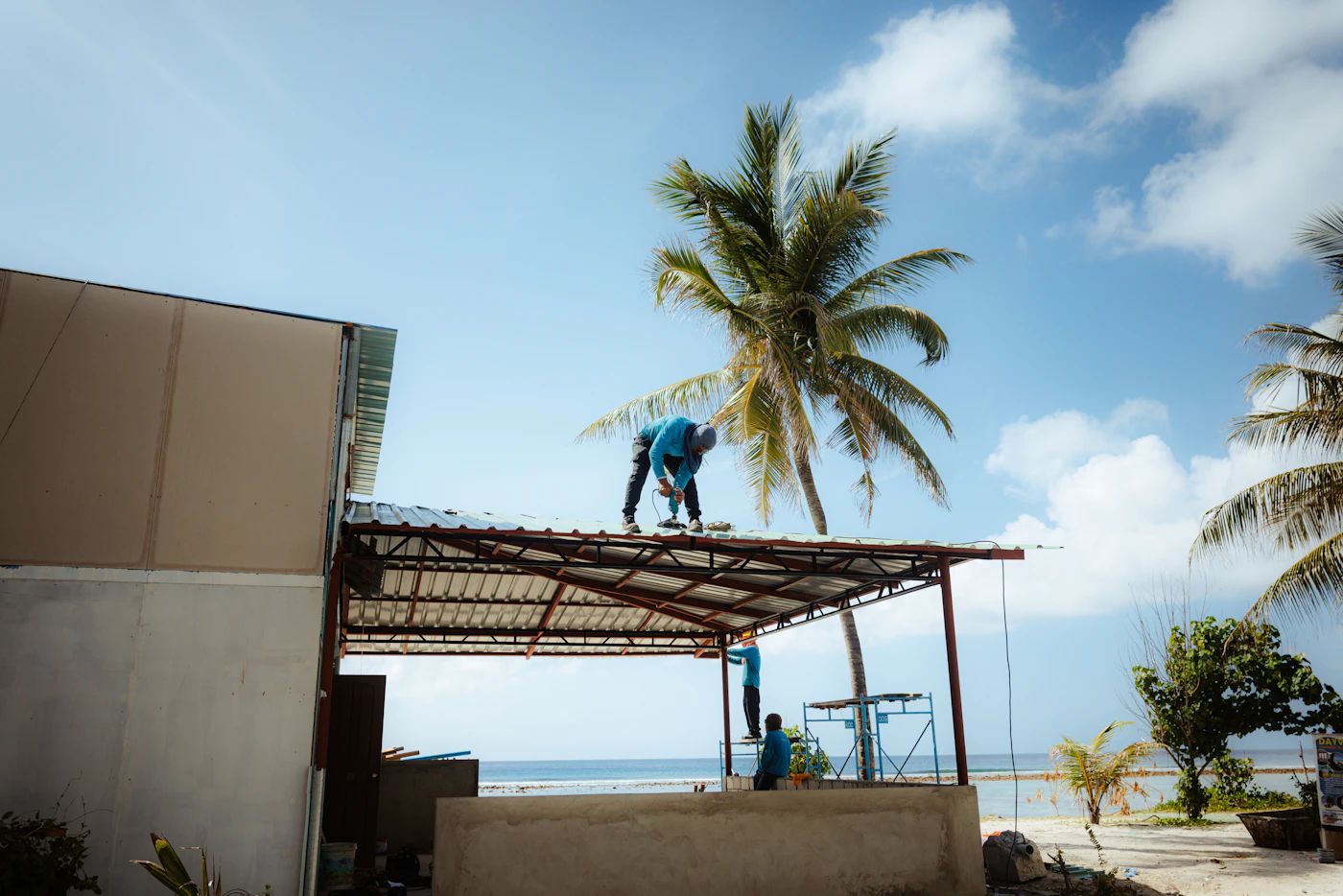
Hot work needs the right coverage.
General liability, workers' comp, tools and equipment and commercial auto for shop and mobile welders, fabricators and structural steel contractors.
Quick answer A welder or welding business typically needs general liability for fire and property damage from hot work, workers' comp, tools and equipment coverage, and commercial auto for welding rigs and trucks.
- Welding is hot work, and fire damage on a job site is one of the most common and costly claims welders face.
- Welding businesses need workers' comp when they have employees, and all licensed contractors will need it from 2028.
- Commercial auto covers a welder's truck, while equipment coverage protects the welding machine and tools.
- Structural steel and height welding work carry higher insurance rates than other welding work.
- Because hot work can start fires, carriers price welding fire risk carefully, and fire watch and permits help.
By Sam Alishahi · CA Insurance License #4348151 · Reviewed November 2026 · En español · How this page is researched
Fire risk on every job
Welding is hot work, and fire damage on a job site is one of the most common and costly claims. Structural and height work add injury risk.
I place welders with carriers that write hot work, from mobile welders to fabrication shops and structural steel erectors.
- General liabilityFire and property damage from hot work.
- Workers' compBurns, eye and fall injuries.
- Tools and equipmentWelders, trucks and gear.
- Commercial autoWelding rigs and trucks.
What underwriters will ask
Having these ready means I can go to market on the first call. The quote form asks for the same things, and anything you don’t know yet can wait.
- Work: shop, field or both.
- Structural: structural steel or height work.
- Payroll: employees and subcontractors.
- Equipment: rigs and tools with values.
- Revenue: annual gross receipts.
- History: current policies and loss runs.
The 35-foot rule and the half-hour fire watch
Federal OSHA's general industry rule, 29 CFR 1910.252, sets the fire prevention steps an underwriter wants to hear you follow.
- Move the work or the combustibles. If the object can't readily be moved, movable fire hazards nearby go to a safe place. Where practicable, combustibles must be relocated at least 35 feet from the work site. Where that's impracticable, they must be protected with flameproofed covers or shielded with guards or curtains. If the hazards can be neither removed nor guarded, the rule says welding and cutting shall not be performed.
- When a fire watch is required. Fire watchers are required wherever other than a minor fire might develop, or when appreciable combustibles are closer than 35 feet to the point of operation, are farther than 35 feet but easily ignited by sparks, are exposed by wall or floor openings within a 35-foot radius, or sit against the opposite side of a metal partition, wall, ceiling or roof where conduction or radiation is likely to ignite them.
- What the watcher does. The watcher has fire extinguishing equipment readily available, is trained in its use and knows how to sound an alarm. The watch is kept for at least a half hour after welding or cutting is completed, to detect and extinguish possible smoldering fires.
- Construction sites. Under 29 CFR 1926.352, extinguishing equipment must be immediately available, and when normal precautions aren't sufficient, people must be assigned to guard against fire during the work and for a sufficient period afterward to ensure no possibility of fire exists. Work on walls, floors and ceilings gets the same precautions on the opposite side.
If you have a written fire watch routine for your crew, send it with your application for general liability.
Stainless steel and hexavalent chromium
OSHA says a major source of worker exposure to hexavalent chromium, or Cr(VI), is hot work such as welding on stainless steel and other alloy steels containing chromium. OSHA states Cr(VI) is known to cause cancer and targets the respiratory system, kidneys, liver, skin and eyes.
- The limit. The permissible exposure limit is 5 micrograms per cubic meter of air as an 8-hour time-weighted average, and the action level is 2.5 micrograms per cubic meter, also as an 8-hour average. Construction work falls under 29 CFR 1926.1126 and general industry, including shop work, under 29 CFR 1910.1026. In California, Cal/OSHA Title 8, Section 5206 sets the same 5 microgram limit and 2.5 microgram action level for general industry.
- Exposure determination. Employers must determine each exposed employee's 8-hour exposure, either through scheduled air monitoring or a performance-oriented option based on any combination of air monitoring, historical monitoring or objective data.
- Shops. The general industry rule requires a demarcated regulated area wherever exposure is, or can reasonably be expected to be, above the limit. Change rooms are required where protective clothing is required, and washing facilities where skin contact occurs. No eating or drinking in regulated areas.
- Medical surveillance. Under both federal rules and Section 5206, it must be made available at no cost to employees exposed at or above the action level for 30 or more days a year, to those with signs or symptoms, and to those exposed in an emergency.
If stainless is a regular part of your work, tell me the share of jobs and whether you have air monitoring results for your workers' comp application.
Welding insurance, answered
Why is welding liability expensive?
Hot work can start fires, so carriers price fire risk carefully. Fire watch and permits help.
Is structural work rated differently?
Yes. Structural steel and height work carry higher rates.
Is my welding rig covered?
Commercial auto covers the truck. Equipment coverage protects the welder and tools.
Do I need workers' comp?
Yes, with employees, and for all licensed contractors from 2028.
Is every process involving chromium covered by OSHA's hexavalent chromium standard?
No. Both federal Cr(VI) rules, 29 CFR 1910.1026 and 1926.1126, exclude a material or process where the employer has objective data showing it cannot release chromium (VI) dusts, fumes or mists at or above 0.5 micrograms per cubic meter as an 8-hour TWA under any expected conditions of use. Exposures to portland cement are also excluded.
How soon must employees be told their hexavalent chromium exposure results?
Under 29 CFR 1910.1026, within 15 work days after the exposure determination, and under the construction rule, 1926.1126, within 5 work days. Cal/OSHA's Section 5206 allows 15 working days. The employer either notifies each affected employee in writing or posts the results where all affected employees can see them.
Do you offer welding insurance outside California?
Yes. Clients across the country send the same quote form. Sam Alishahi is licensed in all 50 states and Washington, DC and places policies there directly. The shopping across carriers works the same way. Rules, minimums and markets differ by state — see insurance requirements by state.
Official sources
- 29 CFR 1910.252 - General requirements (welding, cutting and brazing fire prevention), Cornell LII
- 29 CFR 1926.352 - Fire prevention (construction welding and cutting), Cornell LII
- 29 CFR 1910.253 - Oxygen-fuel gas welding and cutting, Cornell LII
- 29 CFR 1910.1026 - Chromium (VI), general industry, Cornell LII
- 29 CFR 1926.1126 - Chromium (VI), construction, Cornell LII
- OSHA - Hexavalent Chromium
- Cal/OSHA Title 8, Section 4848 - Fire Prevention and Suppression Procedure
- Cal/OSHA Title 8, Section 4850 - Electric welding, General
- Cal/OSHA Title 8, Section 4650 - Storage, Handling, and Use of Cylinders
- Cal/OSHA Title 8, Section 5206 - Chromium (VI)
Send your work details. I'll shop it.
Work type, payroll and revenue are enough to start.
Alishahi Insurance · Saman Alishahi, independent insurance broker, California License #4348151. General information, not a quote or a promise of coverage; coverage depends on underwriting and the terms, conditions and exclusions of the policy actually issued. Some policies may be placed with nonadmitted (surplus lines) insurers, which are not members of the California Insurance Guarantee Association (CIGA).
Tell me how to reach you. I’ll take it from there.
Takes about 30 seconds. Your next step comes by email, and you get an update at every step until your quotes are ready.
(877) 711-4545Answered 24/7 · CA License #4348151
Get a reminder before your renewal.
Tell me when your policy renews and I’ll email you about six weeks before, when it’s worth comparing. One email, no calls.