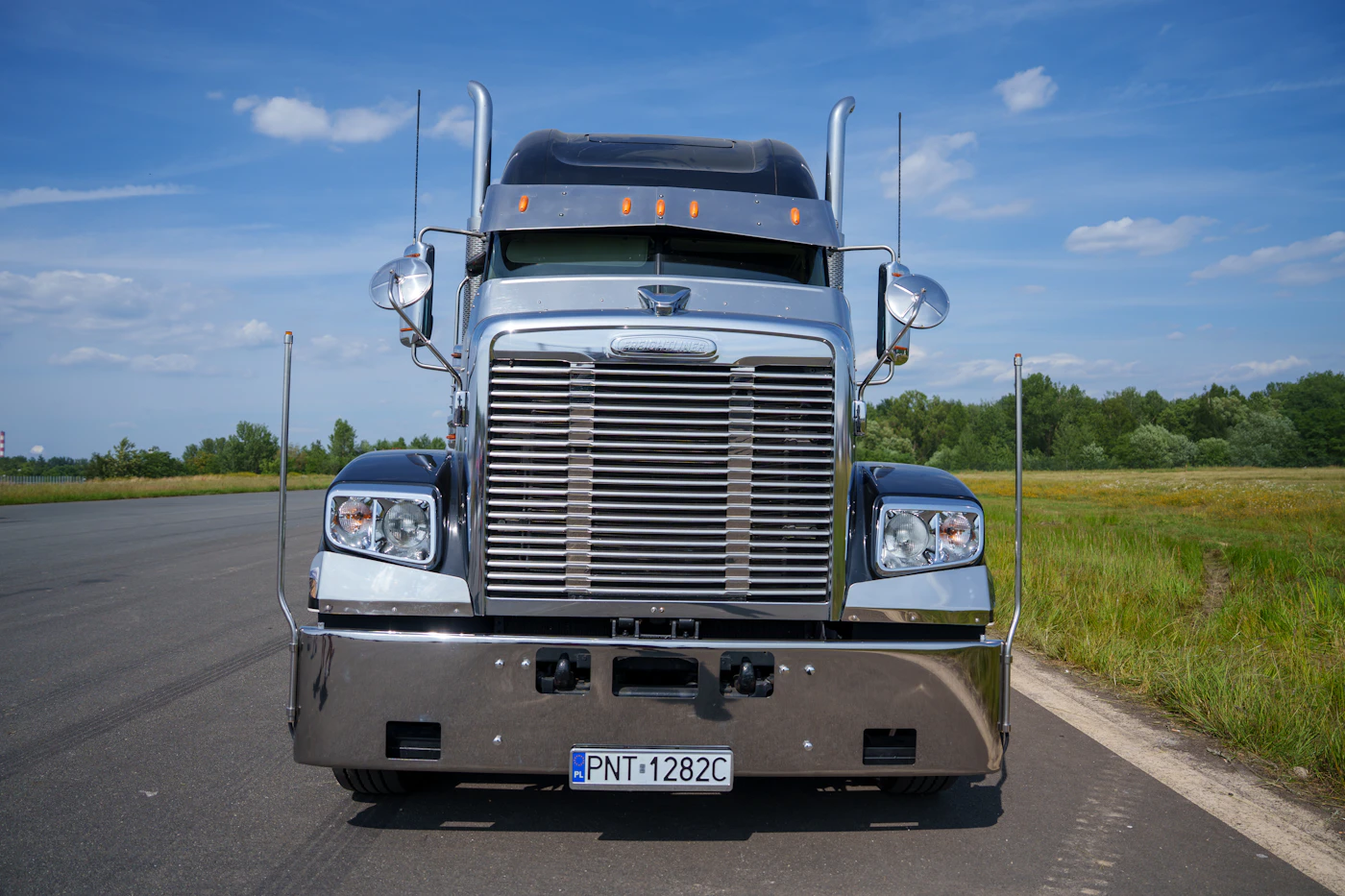
Heavy haul insurance for the machine on your deck.
Auto liability, motor truck cargo and physical damage for carriers and contractors hauling excavators, dozers, cranes and other heavy equipment on lowboys, RGNs and step decks.
By Sam Alishahi · CA Insurance License #4348151 · Reviewed November 2026 · How this page is researched
One load can be worth more than the truck
Heavy haul is different from general freight. A single excavator or crane on your trailer can be worth several times your tractor. Loads are often oversize or overweight, so they move on permits with set routes and sometimes pilot cars. And a lot of the risk happens before the truck moves, while the machine is driven, winched or lifted onto the deck.
Many trucking markets limit equipment loads or cap cargo below what a machine is worth. I look at what you actually haul, your trailers, your permits and who does the loading, then shop carriers that write heavy haul and read the cargo form before you book the load.
- Auto liabilityInjuries and damage your rig causes to others, with the MCS-90 or California MCP filing you need.
- Motor truck cargoDamage to a customer's equipment while it's in your care, with a limit that fits your most valuable load.
- Physical damageYour tractors, lowboys, RGNs and step decks, each listed with its own value.
- General liabilityClaims from time spent at yards, job sites and loading areas.
What underwriters will ask
Having these ready means I can go to market on the first call. The quote form asks for the same things, and anything you don’t know yet can wait.
- Equipment hauled: types of machines and the most valuable single load.
- Trailers: lowboy, RGN, step deck or other, with year and value.
- Permits: how often you run oversize or overweight, and who pulls the permits.
- Loading: who loads and unloads, and whether you rig or crane loads.
- Trucks and drivers: tractor list, driver names and CDL experience.
- Authority and history: USDOT, MC or CA numbers, current policy and loss runs.
Which Caltrans permit fits the move
Caltrans won't write a permit for a size or weight you could make legal by repositioning the load or removing a part, and it won't authorize extralegal weight if the load can be repositioned to stay within the axle-group weights in Vehicle Code 35551 or 35551.5. The weight limits themselves are in the Vehicle Code: 20,000 pounds on any one axle (35550), and a table in 35551 that sets the limit for any group of two or more axles by how far apart they are. For length, 35400 caps a single vehicle at 40 feet and 35401 caps a combination at 65 feet, with exceptions such as the STAA tractor-semitrailer rules in 35401.5. Past those limits, these are the permit types a heavy hauler uses most:
- Single trip. One way, returning unladen or with the same type of load if you ask. Caltrans' manual sets the maximums at 14' wide, 135' overall length, 35' rear overhang from the last point of support, 30' front overhang, a height at least 3" below the lowest structure on the route, and Purple Chart weight.
- Annual. Valid for one year, up to 12' wide and 14' high, with a 40' kingpin-to-rear-axle maximum except where the Vehicle Code allows more. It can't run on any red route in the annual pilot car maps. Renewals can go in up to 60 days early, and Caltrans asks for at least 14 business days to process.
- Variance. For loads over 15' wide, 17' high or 135' long, or on special hauling equipment beyond Caltrans' standard weight classification.
Crossing a state highway with an extralegal load also takes a state permit, even if the rest of the trip is on city or county roads.
Pilot cars and CHP escorts on state highways
Chapter 5 of Caltrans' manual requires pilot cars when:
- The front overhang of a load, or the boom or mast of a crane, drill rig or other fixed-load vehicle, exceeds 25' from the front bumper (or the front tires if there's no bumper).
- The rear load projection exceeds 25' from the last means of support.
- A fixed driven or towed vehicle overhangs more than 30' behind the centerline of the support vehicle's last axle, or a truck crane's unsupported rear boom overhangs more than 30'.
- The load is wider than the lane and will encroach into adjacent lanes, judged by the highway's classification.
Every state route has a color, from least to most restrictive: yellow, green, blue, brown and red. Dashed routes carry a kingpin advisory, and a pilot car is required there when kingpin to rear axle exceeds 38'. The maximum is two pilot cars on yellow, green, blue and brown routes, and one on yellow routes until the load passes 15' wide. With a pilot car, the CHP escorts loads over 16' wide on yellow routes and over 15' on green, blue and brown routes. Loads over 10' wide face weekday curfews in the San Diego, Sacramento and San Francisco areas (7 to 9 a.m. and 4 to 6 p.m.) and Los Angeles (6 to 9 a.m. and 3 to 6 p.m.).
The permittee must brief pilot-car operators before the move, and an operator's failure to follow the permit counts as a violation of its terms. If you hire outside escorts, get their certificate of insurance before the load rolls.
Heavy haul trucking insurance, answered
What is heavy haul trucking insurance?
It's a trucking policy built for oversize, overweight and high-value equipment loads. It usually combines auto liability, motor truck cargo with a high enough limit, physical damage on the tractor and trailer, and general liability for time spent at job sites and yards.
What insurance do I need for a lowboy trailer?
List the lowboy on your physical damage coverage with its own value, so damage to the trailer itself is covered. Liability follows the tractor pulling it. If you haul other people's equipment, you also need motor truck cargo with a limit that fits the machines you carry.
What insurance do I need for hauling construction equipment?
It depends on whose equipment it is. If you haul other people's machines for pay, motor truck cargo covers their equipment while it's in your care. If you're a contractor moving your own machines, cargo coverage usually isn't the answer. Your own equipment is normally covered by a contractor's equipment policy, and your trucks by commercial auto.
How do I get an oversize load permit in California?
For state highways, Caltrans issues transportation permits online through its permit system. Loads over 8 feet 6 inches wide, 14 feet high or 80,000 pounds need a permit, and the load generally has to be one that can't be broken down. A single trip permit is good for seven consecutive days, one way only. Caltrans permits cover state highways, so ask the city or county about any local roads on your route.
Do I need a pilot car for an oversize load in California?
It depends on the load's size and the route. Caltrans publishes pilot car maps that show whether one or two pilot cars are required on each state highway for a given width, length or height. Very wide loads can also need a CHP escort.
How much liability insurance does a heavy haul carrier need?
The federal minimum for for-hire carriers hauling general freight across state lines in trucks of 10,001 lbs or more is $750,000, shown with an MCS-90 endorsement. California's Motor Carrier Permit requires between $300,000 and $5,000,000 depending on the vehicle and what it carries. Equipment owners and general contractors often ask for higher limits in their contracts, so send me the requirement.
Does cargo insurance cover equipment damaged during loading?
Not always. Some cargo forms exclude or limit damage during loading, unloading or rigging, and some exclude certain equipment. Tell me how your loads go on and off the trailer and I'll check the form before you bind.
How far ahead can I get a Caltrans single trip permit?
Caltrans won't issue a single trip permit more than three calendar days before the first travel day. The start date is the issue date unless you ask for a delayed start.
Does California require pilot car driver certification?
The Caltrans permit manual and its pilot car special conditions that I read set escort duties, positions and Vehicle Code equipment rules, but no operator certification. FHWA says there's no national certification program and names Washington, Utah, Colorado, Oklahoma and Florida as states with their own training and certification programs, so check every state on the route.
Do you offer heavy haul trucking insurance outside California?
Yes. Clients across the country send the same quote form. Sam Alishahi is licensed in all 50 states and Washington, DC and places policies there directly. The shopping across carriers works the same way. Rules, minimums and markets differ by state — see insurance requirements by state.
Official sources
- Caltrans: Transportation Permits (oversize and overweight loads on the State Highway System)
- Caltrans: Single Trip Permits
- 49 CFR 387.9: Financial responsibility, minimum levels
- California DMV: Motor Carrier Permits
- Caltrans Transportation Permits Manual, Chapter 1: General Provisions (1/2026)
- Caltrans Transportation Permits Manual, Chapter 2: Types of Permits (6/2022)
- Caltrans Transportation Permits Manual, Chapter 5: Routing and Safety Requirements (6/2024)
- Caltrans: Annual Permit
- Caltrans: Special Conditions for Loads Escorted by Pilot Cars
- Cal. Vehicle Code 35400, 35401, 35401.5, 35550, 35551 (california.public.law)
- FHWA: Best Practices in Permitting of Oversize and Overweight Vehicles, pilot/escort certification
- IRMI: Riggers Liability Insurance
- IRMI: Trailer Interchange Insurance
Tell me what's on your deck. I'll shop it.
Your equipment loads, trailer list, trucks and drivers are enough to start.
Alishahi Insurance · Saman Alishahi, independent insurance broker, California License #4348151. General information, not a quote or a promise of coverage; coverage depends on underwriting and the terms, conditions and exclusions of the policy actually issued. Some policies may be placed with nonadmitted (surplus lines) insurers, which are not members of the California Insurance Guarantee Association (CIGA).
Tell me how to reach you. I’ll take it from there.
Takes about 30 seconds. Your next step comes by email, and you get an update at every step until your quotes are ready.
(877) 711-4545Answered 24/7 · CA License #4348151
Get a reminder before your renewal.
Tell me when your policy renews and I’ll email you about six weeks before, when it’s worth comparing. One email, no calls.