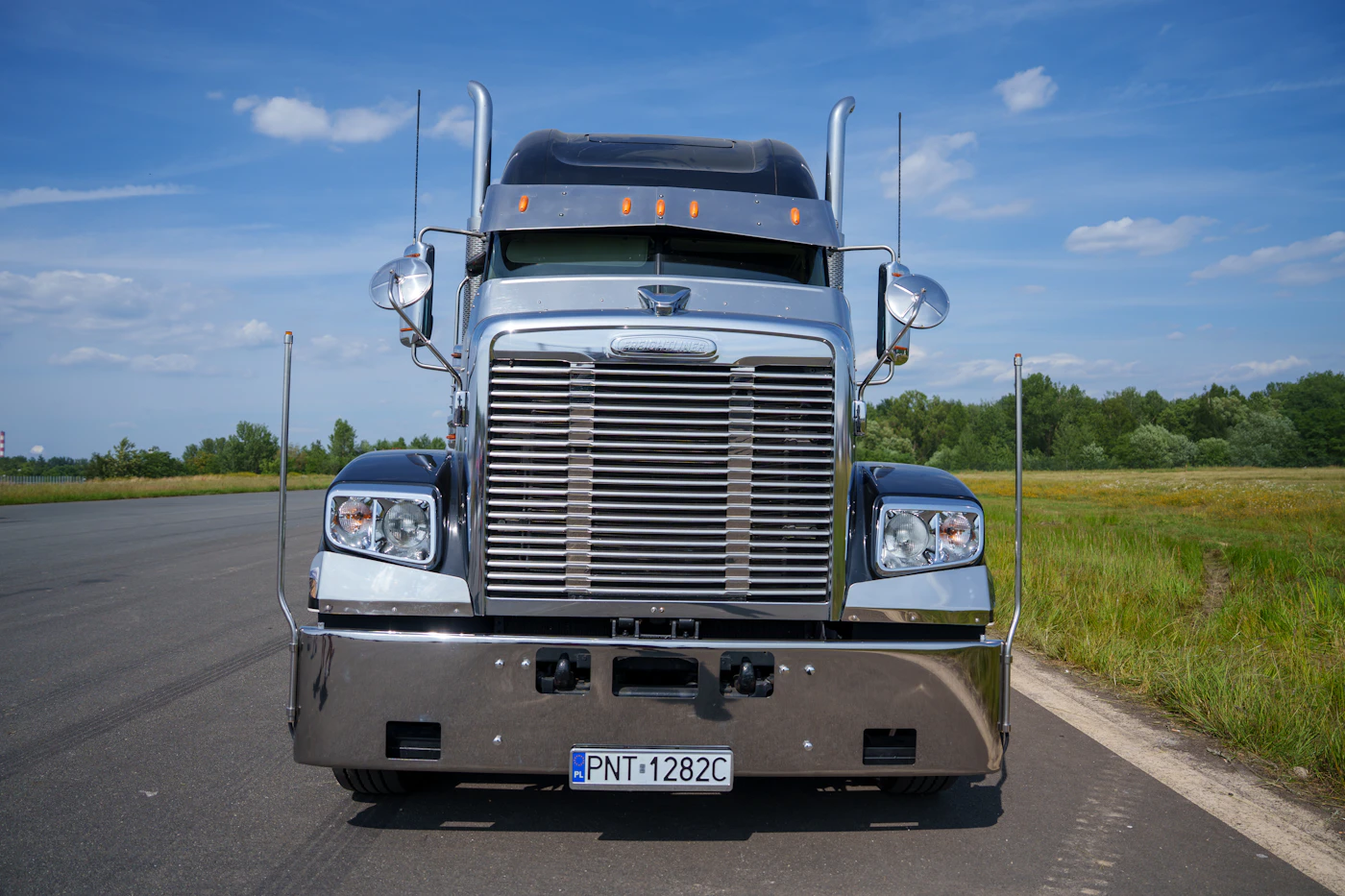
Trucking fleet insurance built around your safety record.
Auto liability, physical damage, cargo, trailer interchange and driver coverage for motor carriers running roughly 5 to 100+ power units.
By Sam Alishahi · CA Insurance License #4348151 · Reviewed November 2026 · En español · How this page is researched
A fleet is underwritten on its data
Once you run more than a few trucks, underwriters stop looking at one driver and one truck. They look at your fleet as a whole: your loss runs, your inspection and crash history, your driver hiring rules and how you manage safety.
FMCSA's Safety Measurement System uses 24 months of roadside inspections, crash reports and investigation results, updated monthly. Many underwriters review the public part of that data before they quote. I put your fleet in front of carriers and programs that write motor carriers your size, including some that use telematics and ELD data in their review.
I build the full package around your contracts: liability limits, a physical damage schedule, cargo, trailer interchange, and coverage for company drivers and leased owner-operators.
- Auto liabilityInjuries and damage your trucks cause to others, with federal filings.
- Physical damageRepairs to your tractors and trailers, scheduled unit by unit.
- Motor truck cargoLoss or damage to the freight you haul.
- Trailer interchangeDamage to non-owned trailers you pull under an interchange agreement.
- Non-trucking liabilityLeased owner-operators driving off dispatch.
- Driver coverageWorkers' comp for company drivers, occupational accident for owner-operators.
What underwriters will ask
Having these ready means I can go to market on the first call. The quote form asks for the same things, and anything you don’t know yet can wait.
- Schedule: every power unit and trailer, with year, VIN, type and value.
- Drivers: list with license state, CDL years, and hire dates.
- Loss runs: 5 years from every carrier you've had.
- Operations: USDOT number, radius, states, commodities and terminals.
- Safety: telematics or ELD provider, safety program and hiring rules.
- Contracts: limits and wording your brokers and shippers require.
The MCS-90 and the 35-day rule
Part 387, Subpart A covers for-hire interstate property carriers and hazmat carriers, generally in vehicles rated 10,001 pounds GVWR or more (387.3). None of them may operate until the minimums in 387.9 are in effect (387.7(a)). When that responsibility is met with insurance, the proof is the Form MCS-90 endorsement issued by the insurer (387.7(d)). Three rules cause most filing trouble:
- The name has to match exactly. Under 387.15, the endorsement must be issued in the exact name of the motor carrier. If your USDOT registration shows an LLC and the policy shows a trade name, fix it first.
- It stays on until someone ends it. 387.7(b)(1) requires the policy and endorsement to remain in effect continuously until terminated. Either the insurer or the carrier can cancel with 35 days' written notice to the other, and the 35 days run from the date the notice is transmitted.
- The proof lives at your office. 387.7(d) requires proof of financial responsibility to be kept at the carrier's principal place of business.
The 35-day rule matters most when you change insurers. Under 387.7(c), the old insurer's liability for later events ends on the replacement policy's effective date or at the end of the 35-day cancellation period, whichever comes first. When I move a fleet, I set the new effective date first, then ask the old insurer to cancel.
Under 387.5, "public liability" includes environmental restoration: restitution for damage to natural resources from an accidental release of a commodity you haul. The federal minimums by commodity are on my FMCSA requirements page.
When a shipper files a cargo claim
Interstate cargo loss and damage claims run under the Carmack Amendment, 49 U.S.C. 14706. It makes carriers liable for the actual loss or injury to the property caused by the receiving carrier, the delivering carrier, or another carrier over whose line or route the freight moved. Your cargo policy has its own terms, but the handling rules in 49 CFR Part 370 apply either way.
- Filing time. A carrier cannot set less than 9 months to file a claim, or less than 2 years to bring a civil action. The 2 years run from the date the carrier gives written notice that it has disallowed any part of the claim (14706(e)(1)).
- What counts as a claim. Under 370.3(b), a written claim must identify the shipment, assert liability for the loss, damage, injury or delay, and ask for a specified or determinable amount of money. A damage notation on a delivery receipt alone is not a claim (370.3(c)).
- 30 days to acknowledge. 370.5(a) requires written acknowledgment within 30 days of receipt, unless you pay or decline in writing within that time. Under 370.5(b), each claim gets its own file and a successive claim number.
- 120 days to resolve. 370.9(a) requires you to pay, decline or make a firm compromise offer in writing within 120 days. If you can't, give the claimant a written status and reason for the delay, then again every 60 days while it stays open.
Report the loss to your cargo insurer as soon as the shipper raises it. A missed deadline is a separate problem from the loss itself. To check what your form excludes, read why cargo claims get denied before you need it.
Trucking fleet insurance, answered
What is fleet insurance for trucking companies?
It's one program that covers all of a motor carrier's trucks, trailers and drivers. It usually includes auto liability, physical damage on a schedule of units, motor truck cargo, and often trailer interchange and general liability. Driver coverage, such as workers' comp or occupational accident, is set up alongside it.
How do CSA scores affect insurance?
FMCSA's Safety Measurement System ranks carriers in seven BASICs using 24 months of inspection, crash and investigation data. Many underwriters review the public BASICs and your inspection history. Alerts in areas like Unsafe Driving or Hours-of-Service can mean more questions or fewer markets. FMCSA itself says not to judge a carrier's overall safety on that data alone, so I send underwriters context on what you've fixed.
How do I get insurance for 10 trucks?
Send me a schedule of the 10 units and trailers, a driver list, 5 years of loss runs and your USDOT number. At that size, carriers look at the whole operation, not just each truck, so a clean schedule and complete loss runs matter.
What liability limit does a trucking fleet need?
The federal minimum for for-hire carriers hauling non-hazardous property in interstate commerce, in trucks of 10,001 pounds or more, is $750,000. Many broker and shipper contracts ask for $1,000,000. Certain hazardous materials require $1,000,000 or $5,000,000.
Do telematics or ELD data help with fleet insurance?
Some carriers and programs ask for telematics or ELD data and use it in underwriting. It can show how your drivers actually drive. How much it counts depends on the carrier, so I can't promise a result, but I can match you with markets that review it.
What do insurers look for in fleet drivers?
Driving records, CDL experience, and how you hire. Federal rules require a motor carrier to get each new driver's 3-year motor vehicle record and to check their safety history with DOT-regulated employers from the past 3 years. Written hiring standards help underwriters.
Do leased owner-operators need their own insurance?
Often, yes. The motor carrier's liability usually applies while the truck is operating under its authority. Owner-operators commonly carry non-trucking liability for off-dispatch use, plus occupational accident or physical damage on their own truck. Your lease terms decide who carries what, so I review them.
How often do I have to query the FMCSA Clearinghouse for my drivers?
Run a full query before a driver first performs safety-sensitive work, then at least one query a year for each driver subject to testing (49 CFR 382.701). The annual check can be a limited query. If it shows information, a full query is due within 24 hours.
How often does a truck need a Clean Truck Check test in California?
Most trucks over 14,000 pounds GVWR have deadlines every six months, set by the DMV registration month or, for trucks never registered in California, the VIN's last digit. CARB says OBD-equipped vehicles move to four tests a year beginning October 2027.
Do you offer trucking fleet insurance outside California?
Yes. Clients across the country send the same quote form. Sam Alishahi is licensed in all 50 states and Washington, DC and places policies there directly. The shopping across carriers works the same way. Rules, minimums and markets differ by state — see insurance requirements by state.
Official sources
- 49 CFR 387.9: minimum levels of financial responsibility for motor carriers
- FMCSA CSA: how the Safety Measurement System measures carriers
- FMCSA Safety Measurement System (SMS) public data
- 49 CFR 391.23: driver investigation and inquiries
- 49 CFR Part 387, Subpart A (387.3 applicability, 387.5 definitions, 387.7 financial responsibility, 387.15 forms) - eCFR
- 49 CFR 391.51 - General requirements for driver qualification files - eCFR
- 49 CFR 382.701 - Drug and Alcohol Clearinghouse - eCFR
- 49 U.S.C. 14706 - Liability of carriers under receipts and bills of lading (Carmack)
- 49 CFR Part 370 - Principles and practices for the investigation and voluntary disposition of loss and damage claims - eCFR
- CARB - Clean Truck Check overview fact sheet
- CARB - Clean Truck Check requirements for vehicles subject to semi-annual compliance
- CARB - Clean Truck Check (HD I/M) program page
Send your schedule and loss runs. I'll shop it.
Your unit schedule, driver list, 5 years of loss runs and USDOT number are enough to start.
Alishahi Insurance · Saman Alishahi, independent insurance broker, California License #4348151. General information, not a quote or a promise of coverage; coverage depends on underwriting and the terms, conditions and exclusions of the policy actually issued.
Tell me how to reach you. I’ll take it from there.
Takes about 30 seconds. Your next step comes by email, and you get an update at every step until your quotes are ready.
(877) 711-4545Answered 24/7 · CA License #4348151
Get a reminder before your renewal.
Tell me when your policy renews and I’ll email you about six weeks before, when it’s worth comparing. One email, no calls.