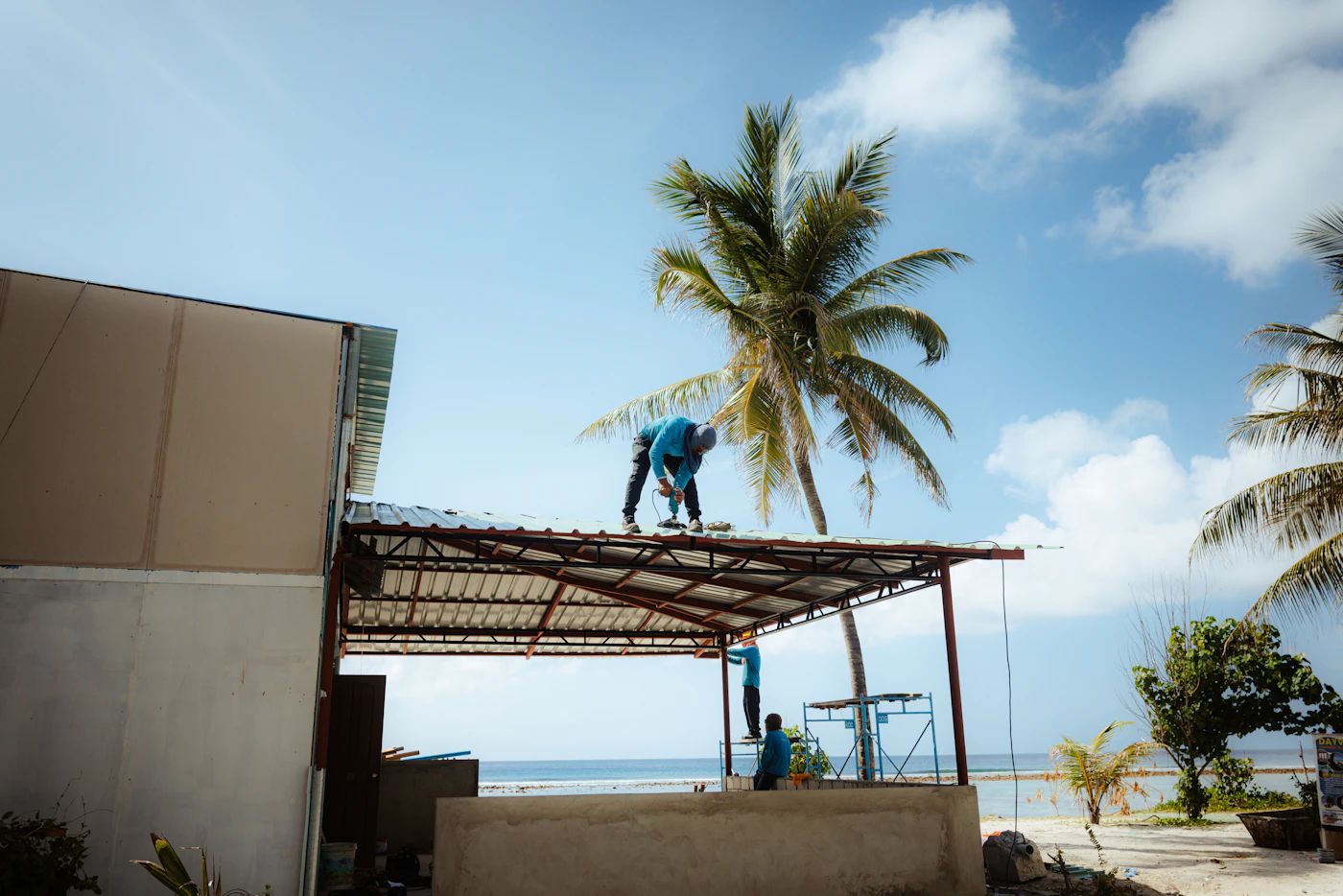
Solar insurance from the roof to the panel.
General liability, workers' compensation, equipment and commercial auto for residential and commercial solar installers and battery storage contractors.
By Sam Alishahi · CA Insurance License #4348151 · Reviewed November 2026 · How this page is researched
Roof work and electrical work in one trade
Solar installers combine roof work, where falls are the main injury risk, with electrical work, where fire and roof leaks bring liability claims. Many carriers limit or decline the class.
I place solar contractors with carriers that write the trade, including battery storage and EV charger work, and keep certificates coming for homeowners, developers and general contractors.
- General liabilityRoof leaks, fire and property damage.
- Workers' compCrews on roofs and in attics.
- EquipmentPanels and inverters in transit and on site.
- Commercial autoTrucks and trailers.
What underwriters will ask
Having these ready means I can go to market on the first call. The quote form asks for the same things, and anything you don’t know yet can wait.
- License: CSLB number and classifications.
- Work: residential, commercial or ground mount.
- Add-ons: battery storage, EV chargers or roofing.
- Payroll: employees, payroll and subcontractor costs.
- Revenue: annual gross receipts.
- History: current policies and loss runs.
The disclosure that tops every residential solar contract
If you sell residential solar in California, the first page of your contract is set by statute. Business and Professions Code 7169 requires the solar energy system company to give the consumer a Solar Energy System Disclosure Document before completing a sale, financing or lease. The CPUC says this single-page cover page has been in effect since January 1, 2019.
- Where it goes. On the front or cover page of every solar energy contract, in boldface 16-point type.
- What it states. Total cost and payments, including financing costs; how and to whom the consumer can file a complaint; and the consumer's cancellation right under Section 7159.
- Which language. The contract and disclosure must be in the language principally used in the oral sales presentation or in the print or digital marketing given to the consumer (7169(d)).
- Which jobs. Solar systems on residential buildings, primarily generating electricity, rated at least 1 kW and no more than 5 MW AC. It does not apply to a system installed as a standard feature on new construction.
- The second document. The CPUC says the longer Solar Energy System Supporting Information document has been in effect since November 1, 2025, and Version 2, issued July 28, 2025, is the one to submit with interconnection applications. Customers must get both documents before a contract is signed, and both must be submitted to the utility for an interconnection application to be considered complete.
- Typed, not handwritten. Under CPUC Resolution E-5364 the supporting form must be typewritten. The CPUC warns that a handwritten form may bring penalties and placement on its Public Watch List of Non-Compliant Solar Providers.
The CPUC says the documents are not required when a battery storage system is not being connected to an existing or new generation system. Keep a signed copy of both in every job file.
Cal/OSHA fall rules on a solar roof
Cal/OSHA's Title 8 rules decide what fall protection a solar crew needs, and which rule applies depends on the roof and the work.
- Section 1670(a). Approved personal fall arrest, restraint or positioning systems must be worn by employees exposed to falls of more than 7 1/2 feet from the perimeter of a structure, unprotected sides and edges, leading edges, openings, or sloped roof surfaces steeper than 7:12, unless they are otherwise adequately protected under the safety orders. A note to the section points roofing operations to Section 1730.
- Section 1731 (residential-type roofing). If your company also does roofing or re-roofing on single-family homes, workers on slopes from 0:12 to 7:12 must be protected once the fall distance is 6 feet or more. On roofs steeper than 7:12 they must be protected regardless of height. Required training covers topics including roof holes and openings, skylights, ladders and roof access.
- Section 1632 (openings). Roof and skylight openings must be guarded by temporary railings and toeboards or by covers. Covers must support the greater of 400 pounds or twice the weight of the workers, equipment and materials on them, be secured in place, and be marked "Opening--Do Not Remove."
Here is what enforcement looks like. In June 2019, Cal/OSHA announced citations against an Anaheim solar installer after a worker installing panels on an Oakland home lost his footing and fell 15 feet onto the concrete driveway. Cal/OSHA said the company did not provide required fall protection, and that violation was classified as willful serious. A separate burn incident brought a citation for not providing insulated gloves or tools for energized work.
When I take a solar account to market for workers' comp, I send a written fall protection program, training records and a description of your energized-work procedures, so the underwriter sees more than a payroll figure.
Solar contractor insurance, answered
Does liability cover a roof leak after an install?
Liability can cover damage to the home's interior caused by your work. Redoing the installation itself is typically not covered.
Do solar contractors need workers' comp?
Yes, with employees. From 2028, California will require it for all licensed contractors.
Are panels covered before they're installed?
With installation floater or equipment coverage, materials can be covered in transit and on the job site.
Why is solar insurance hard to place?
Roof work and electrical work together make it a restricted class for many carriers. Specialty markets write it.
Do you offer solar contractor insurance outside California?
Yes. Clients across the country send the same quote form. Sam Alishahi is licensed in all 50 states and Washington, DC and places policies there directly. The shopping across carriers works the same way. Rules, minimums and markets differ by state — see insurance requirements by state.
Official sources
- Cal. Bus. & Prof. Code 7169 (Solar Energy System Disclosure Document)
- CPUC: CSLB Disclosure Documents (California Solar Consumer Protection Guide)
- Cal. Civ. Code 1689.6 (home solicitation cancellation periods)
- Cal. Bus. & Prof. Code 7159 (home improvement contracts)
- 16 CFR 429.1 (FTC cooling-off rule)
- Cal. Code Regs. tit. 8, 1670 (personal fall arrest systems)
- Cal. Code Regs. tit. 8, 1731 (residential-type roofing); see also 1632 (roof openings) at dir.ca.gov/title8/1632.html
- Cal/OSHA news release 2019-47 (solar installer fall citations)
- Cal. Gov. Code 65850.5 (expedited solar permitting)
- Cal. Gov. Code 65850.52 (automated solar permitting platform)
Send your license number. I'll shop it.
Your CSLB number, payroll and revenue are enough to start.
Alishahi Insurance · Saman Alishahi, independent insurance broker, California License #4348151. General information, not a quote or a promise of coverage; coverage depends on underwriting and the terms, conditions and exclusions of the policy actually issued. Some policies may be placed with nonadmitted (surplus lines) insurers, which are not members of the California Insurance Guarantee Association (CIGA).
Tell me how to reach you. I’ll take it from there.
Takes about 30 seconds. Your next step comes by email, and you get an update at every step until your quotes are ready.
(877) 711-4545Answered 24/7 · CA License #4348151
Get a reminder before your renewal.
Tell me when your policy renews and I’ll email you about six weeks before, when it’s worth comparing. One email, no calls.